Environmental Health
SBC of Environmental Health Threats for Children
Introdução

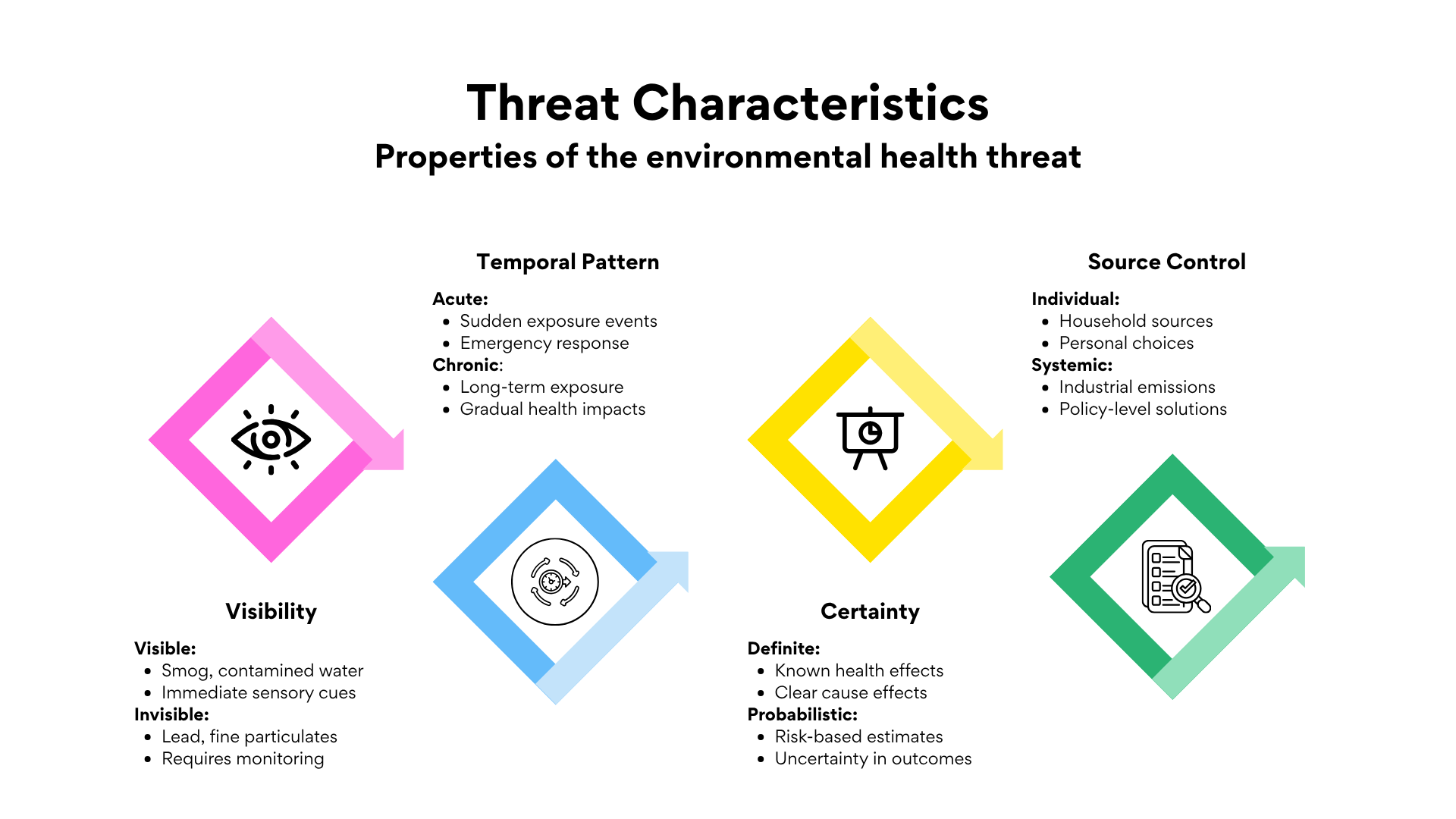
Recognise : Making the invisible, visible
The Sensory Gap Problem:
• Humans evolved to respond to immediate, visible threats (predators, fire, contaminated food)
• Environmental health threats operate below sensory thresholds
• E.g. Research from Bangladesh shows citizens' perception of air quality correlates poorly with actual measurements
Theories:
Risk Perception Theory:
• Risk perception requires both cognitive understanding AND emotional salience
• The "risk perception paradox": High awareness ≠ protective action without perceptual availability
Availability Heuristic:
• People judge probability by ease of recall/imagination
• Invisible threats are cognitively "unavailable" → systematically underestimated
Protection Motivation Theory:
• Threat appraisal requires perceived severity AND vulnerability
• Without sensory detection, both remain abstract concepts
Sensory Detection
- Direct sensing: Using human senses when possible
- Proxy indicators: Observable signs that correlate with invisible threats
- Technology aids: Monitors, apps, and measurement tools
- Biological markers: Health symptoms that indicate exposure
Engage: Motivating knowledge
The Awareness-Action Gap
• Information alone rarely changes behaviour
• Environmental health competes with immediate survival needs
• Emotional connection drives prioritization
Theories
Value-Belief-Norm Theory (Stern, 2000)
• Personal values → beliefs about consequences → moral obligation → action
• Environmental concern correlates only modestly with behaviour
• Need emotional activation of existing values
Risk-as-Feelings Theory (Loewenstein et al., 2001)
• Emotional reactions to risk often diverge from cognitive assessments
• Affect heuristic: Feelings guide judgments more than analysis
• Vividness, proximity, and similarity trigger stronger emotional response
Construal Level Theory (Trope & Liberman, 2010)
• Psychological distance affects prioritization (temporal, social, spatial)
• Distant/abstract threats = low priority; Near/concrete = high priority
• Reducing psychological distance increases engagemen
Act: Taking action
The Intention-Action Gap
• 70% of motivated people fail to sustain new behaviours
• Knowledge + motivation ≠ action without capability
• Skills, confidence, and support systems essential
Theories
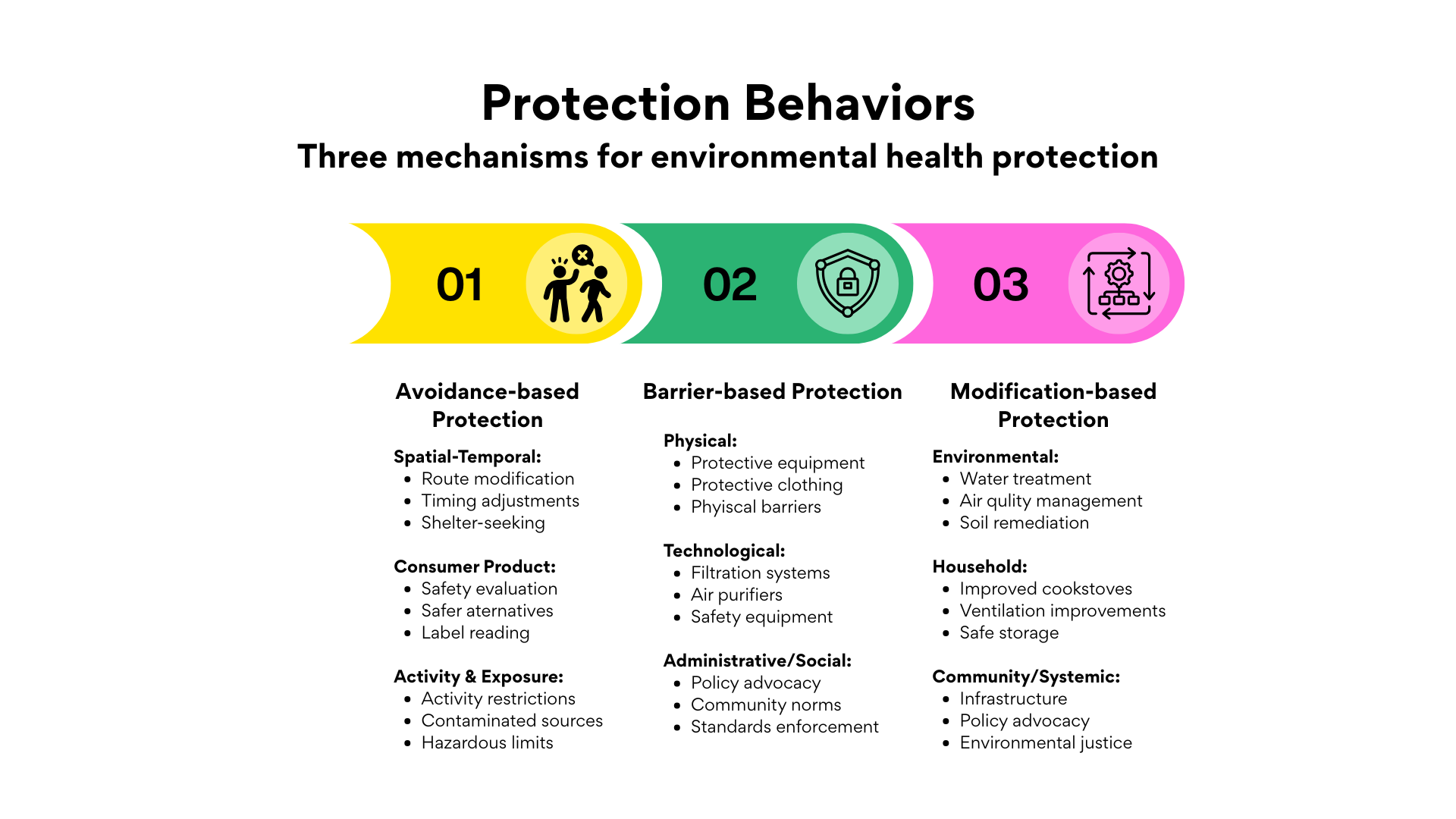
COM-B Model (Michie et al., 2011)
• Capability (physical/psychological) + Opportunity + Motivation = Behavior
• COM-B based cookstove intervention in Uganda resulted in 72,535 improved cookstoves sold, achieving 36% reduction in fuel consumption
• Application: Address all three components systematically
Protection Motivation Theory (PMT)
• Response efficacy: Belief that the action will work
• Self-efficacy: Confidence in ability to perform the action
• Response costs: Barriers to performing the action
Protective Action Decision Model (PADM) (Lindell & Perry, 2004)
• Covers the full decision-to-implementation pathway
• Protective action search: Finding feasible options
• Protective action assessment: Evaluating options
• Protective action implementation: Actually doing it
Context: Structural Conditions
The Structure -Agency Gap
• Individual agency operates within structural constraints
• Protective behaviours require enabling conditions
• Knowledge + motivation ≠ action without supportive context
Theories
Social Ecological Model (Bronfenbrenner)
• Individual behaviour nested within multiple system levels
• Environmental factors shape behavioural possibilities
• Structural interventions have cascade effects across levels
Capability Approach (Sen, 1999)
• Distinction between capabilities and functions • Resources + conversion factors = real opportunities
• Context determines what behaviours are actually possible
Habit: Creating lasting change
Action Over Time and interacting with structure
• Conscious decision-making is cognitively taxing
• Competing priorities erode initial motivation
• Protection behaviours require constant willpower without habit
Theories
Dual Process Theory (Kahneman, 2011)
• System 1 (automatic) vs System 2 (deliberative) thinking
• Habits shift behaviour from effortful System 2 to automatic System 1
• Environmental cues trigger responses without conscious decision
Habit Loop Model (Duhigg, 2012)
• Cue → Routine → Reward creates neurological patterns
• Habits formed in stable, consistent environments are more likely to become automatic Repetition in consistent contexts builds automaticity


3 Communication Guide have been developped based on the REACH Framework.
- Lead Poisoning Prevention Message Guide
- Air Pollution Prevention Message Guide
- Extreme Heat Prevention Message Guide