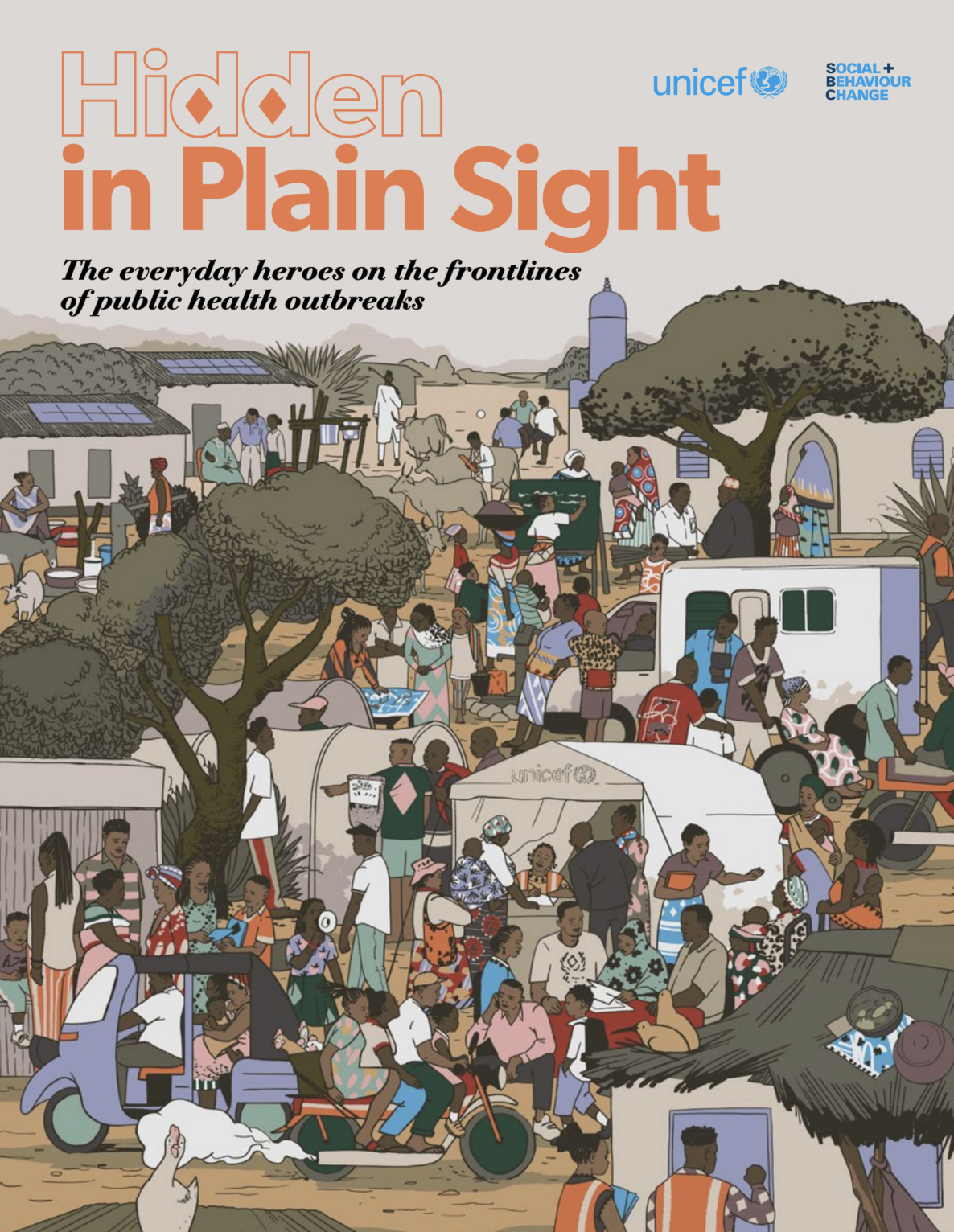
Change Magazine: Hidden in Plain Sight
The everyday heroes on the frontlines of public health outbreaks
Introducción
Discover the New Change Magazine: Hidden in Plain Sight!

UNICEF SBC's new edition of Change Magazine: Hidden in Plain Sight. Explore the untold narratives, what went right (and what didn’t) in the mpox outbreak response: featuring the frontline knowledge, thoughtful global perspectives we need to prepare for the next public health emergency.
You can watch the below video on the conversation UNICEF SBC had for the launch of the magazine on Risk Communication and Community Engagement (RCCE) & Children.
Jump to translated magazine content
Cover Page Illustration Solutions
Take it from me: An mpox survivor's journey to public health advocacy
Hidden Scars: Stigma and Resilience after mpox
Community engagement at the heart of change: when communities make their voices heard
Champion in Chief: How one village chief slowed the spread in DRC
Cover Page Illustration Solutions
Throughout the cover illustration, the heroes of outbreak response are quietly woven into the crowd. Each one carries a small gem symbol—tucked into clothing, patterns, or accessories.How many did you find? See below for the location of all 12 heroes!

TRANSLATED ARTICLES: English of French magazine articles:
--------------------

Take it from me: An mpox survivor's journey to public health advocacy
Frontline Heroes: Jeanine Ndayisaba, Burundi
There was no slowing down for Jeanine Ndayisaba, a mother of six and street vendor, who sells avocados and bananas in the Magarama neighborhood of Gitega. But in January of 2025 after several days of fever followed by a new spot on her face, she realized it was time to take a break. She decided to go to the hospital because she had heard messages on the radio and from health workers urging people to seek care for symptoms like hers. Her test results came back positive for mpox and her life turned upside down. It was the beginning of a battle that was both personal and collective.
Jeanine spent over two weeks in the Gitega Regional Hospital treatment center, isolated from her children who were being cared for by neighbors. Despite the pain and distress of Jeanine’s first-ever hospitalization, she learned the importance of prevention. “They explained the symptoms, how it is transmitted, and above all, how to protect ourselves,” she says.
Upon her release, she and other recovered patients received a handwashing kit. She installed the kit at the entrance of her house and urged her children and visitors to follow hygiene rules. Day by day, Jeanine grew to be a point of reference for mpox in her community. She raises awareness and gives advice and guidance to people who are showing symptoms. Thanks to Jeanine’s encouragement, one of her neighbors who was hesitant to seek care for his skin rashes finally agreed to get tested. When his test came back positive for mpox, he received treatment and recovered.
For Jeanine, being an mpox survivor and advocate has been far from easy. When she returned to the markets to sell fruit, her fellow vendors initially rejected her. “If you know so much about mpox, how did you catch the disease?” they would snap at her. But with the support of community health workers, their attitudes are changing.
A UNICEF partner organization invited Jeanine to attend a training course where her role as an advocate was recognized and valued. She feels like a community health worker, invested in the mission and passionate about serving her community. “I believe I have helped save lives,” she says.
Today Jeanine is proud of her journey. She hopes to inspire others to join the fight against mpox: “When faced with a disease like mpox, every action counts, and regardless of your status, you can become a public health advocate.”
--------------------

Hidden Scars
Stigma and Resilience after Mpox
After enduring fever and lesions, many survivors in the Democratic Republic of the Congo and Burundi face an even more insidious battle: rejection, whispers, and shame.
“Not even my brother wanted to come near me,” recounts Patrick, 19, from DRC. After returning from the treatment centre, his life was turned upside down: his siblings rejected him even though they were vaccinated, he was isolated at school, and his choir friends no longer sang with him. Patrick even considered going to live with his grandmother in Goma, where no one knew about his illness. “Even when I was cured, I was no longer welcome at home,”
Claudine, 56, an influential figure in DRC, a believer and devout practitioner, experienced another kind of exile: one she imposed on herself. Although deeply engaged in disease prevention within her community, shame overwhelmed her when she received her diagnosis. “I couldn’t bear to be seen with the symptoms of mpox,” she admits. Once cured, Claudine spoke about it to her loved ones, but her fears were sadly confirmed: she was sidelined. “I trained others on mpox. But when I caught it myself, I hid away,”
In Burundi, stigma strikes women who are already marginalised even harder. Chantal, a 34-year-old sex worker living in Burundi with her three children, lives with HIV. She was pregnant when she fell ill. Her return from the hospital was marked by exclusion from both her neighbours and her children. “I had to give up my bed,” she murmurs. Everything disappeared - clients, food, everything… except the scars. “Even after my recovery, I was forbidden from using the communal toilets,”
At 18, life has not been kind to Adeline : a sex worker since the age of 9, orphaned and a single mother, she also endured the stigma that came with mpox. The disease was a true ordeal. “I would rather bear the pain of childbirth,” she recalls. But the moral pain lasted longer and cut deeper. Forced into isolation by her landlord, unable to work to afford treatment, she turned to begging despite the shame and suffering. “People threw money at me to avoid touching me. I ended up spending my days in town to avoid those who knew me.”
These stories are not isolated. When a disease becomes a moral judgement rather than a medical reality, people are driven into hiding - far from treatment, support, and dignity - plunged into silence and shame.
Things have since evolved: Patrick raises awareness about mpox and stigma at his school, Claudine shares her story at work and in her community, Chantal guides other sex workers towards testing, and Adeline carefully watches for symptoms among her clients. They found the strength to rise again and have become actors of positive change within their communities.
The fight against communicable diseases depends as much on tackling stigma as it does on medical care - yet, sadly, stigma prevention has rarely been prioritised in emergency responses. Support and empathy, listening and compassion, will be just as indispensable to health systems and communities as they prepare to face future epidemics.
--------------------

Community engagement at the heart of change: when communities make their voices heard
Shouting in the street with a megaphone is a surprising form of community engagement, to say the least, yet this is precisely the role that Alphonsine Molangi has taken on.
In 2021, the 60-year-old teacher promoted Ebola and COVID-19 prevention as part of a plan developed by the Community Activation Cells (CAC) in the Democratic Republic of Congo (DRC) to help communities cope with epidemics.
A government initiative launched in 2012, the CACs were reactivated in 2018 during the world's second-largest Ebola epidemic. Their members, elected by their communities, are trained and equipped to develop local response plans, support daily Risk Communication and Community Engagement (RCCE) activities, contribute to community surveillance, and liaise with response coordination mechanisms.
Although the foundations of participatory, community-based action and the empowerment of marginalized groups were theorized more than 50 years ago, their implementation has always been fraught with difficulties. According to this theory, community engagement relies on communities themselves implementing solutions to address issues that directly affect them, using their own resources. This is exactly what Alphonsine does with her megaphone, and no outside intervention - despite the resources hidden behind logos - can replace the closeness and trust that her voice inspires.
Although historical and political events (notably colonization, the dynamics of international aid, and the governance models that followed) have led some communities to lack confidence and doubt their skills and their right to decide, it is possible to create the conditions for a return to local leadership.
During the mpox epidemic of 2024-2025, the human-centered approach made it possible to directly involve affected individuals and survivors in the co-creation of concrete solutions: in Uganda, videos co-produced by drivers, who were both the target audience and the originators of the idea, addressed perceptions of the high costs of the health system; in Burundi, a comic book aimed at raising awareness and preventing sexual exploitation and abuse was the result of a collective discussion within the affected communities.
In the DRC, while the flourishing number of CAC groups is testament to their skills and adaptability acquired during the Ebola, COVID-19, cholera, and mpox epidemics of the past decade, it reveals nothing of the constant and profound difficulties linked to the lack of funding and investment in local capacities.
CAC members, who are volunteers with very limited resources, continue to take on more and more responsibilities. For many years, their efforts were rewarded with transportation allowances and other small direct payments. But this practice proved unsustainable, even causing tensions with local health teams, who themselves are rarely paid regularly. A more sustainable and effective solution has been found with the financing of income-generating activities (IGA) in exchange for which the community contributes to improving disease surveillance, prevention, and response. Thanks to IGA, communities are able to provide for themselves, which strengthens their resilience, reduces poverty, and enhances long-term economic stability. These initiatives, which continue outside of acute emergency phases, thus constitute a genuine form of local crisis preparedness.
So don't be surprised to see Alphonsine and her colleagues at the CAC, mostly women, converting small financial grants from organizations such as UNICEF to rent chairs for weddings or funerals, raise chickens, or harvest vegetables to sell at the market, while organizing the next local action. This is how communities empower themselves to take matters into their own hands and drive change on their own terms.
--------------------

Champion in Chief: How one village chief slowed the spread in DRC
Frontline Heroes: Joseph Lushuguri Bijundi, DRC
As the chief of Kabikwinja, a village in the Walungu health zone of South Kivu, 64-year-old Joseph Lushuguri Bijundi wears many hats. Since the resurgence of mpox, he has joined the frontlines in the battle to stop the spread.
Trained in RCCE (Risk Communication and Community Engagement) strategies and community-based surveillance by UNICEF through its partners, Joseph plays a key role as a social mobilizer. He raises awareness about preventive measures, monitors contact cases, searches for suspected cases, and refers them to healthcare facilities, or the CTMpox - a treatment center for mpox.
This is a challenge in Joseph’s region, where armed conflict and security instability is a chronic concern. He has encountered people who refuse to transfer to the CTMpox, citing mpox as a shameful disease, reserved for certain categories of people (such as sex workers). Still, his commitment remains unwavering. He risks his own safety, visiting the homes of sick people to explain the dangers of the disease and convince families to transfer their sick relatives to the CTMpox.
“I have overcome several cases of reluctance and refusal related to the transfer of patients to the CTMpox. I have also ensured community surveillance and mobilization around mpox, using the advice cards and tools received from the health zone,” he says.
There are some members of his community that believe Joseph’s commitment is motivated by remuneration, which he strongly refutes. For him, the safety of his community is his number one priority - this includes his own family. He finds great pride in helping community members access treatment, who might have otherwise contributed to the spread of mpox in his village.
Joseph claims that his newfound role in the mpox response has made him a better leader: “I have learned that eradicating an epidemic is based on community-based surveillance and the involvement of all stakeholders. These activities have brought me closer to my community, strengthened trust, and increased my reputation within the community.”
Go to the top.